Wheel alignment is one of those maintenance items that disappears into the background when everything is working correctly, and announces itself loudly through tire bills and fuel costs when it is not. On a passenger car, a misaligned front axle might cost an owner a set of tires prematurely. On a commercial truck with four to eighteen tires across multiple axles, misalignment at any point in the axle train can cost a fleet thousands of dollars annually in accelerated tire wear, increased fuel consumption, and suspension component fatigue – all while the driver adapts to compensating steering inputs without recognizing that anything is wrong.
Industry data consistently shows that the majority of commercial trucks operating on North American roads are running out of alignment to some degree. A significant proportion of those have alignment deviations significant enough to be shortening tire life and degrading fuel economy measurably. Understanding what commercial truck alignment actually involves – which is substantially more complex than passenger car alignment – and why it matters economically is the foundation of treating it as a maintenance priority rather than an optional service.
How Commercial Truck Alignment Differs from Passenger Vehicle Alignment
A passenger car alignment addresses two or four wheels, adjusting camber, toe, and caster to bring the suspension geometry within manufacturer specifications. The goal is even tire wear, proper steering feel, and straight-line tracking. Commercial truck alignment addresses a fundamentally more complex system: a steer axle, one or more drive axles, and often trailer axles as well, each of which can affect the alignment performance of the others in ways that a simple front-end check cannot detect or correct.
The steer axle sets the direction the vehicle travels. It is adjusted for toe – the inward or outward angle of the front tires relative to the vehicle centerline – and for caster, which governs steering return-to-center behavior and directional stability. Both measurements must be within specification for the steer tires to wear evenly and the truck to track straight without constant driver correction.
Drive axles introduce a different alignment dimension: thrust angle, which describes the direction each drive axle is actually pushing the vehicle relative to the frame centerline. A drive axle that is not perpendicular to the vehicle centerline pushes the truck at a slight angle, requiring the driver to counter-steer to maintain a straight path. The steer axle then compensates for the drive axle’s misalignment by pointing slightly sideways, which creates accelerated and uneven wear on the steer tires – wear that looks like a steering problem when the root cause is actually the drive axle. This is why fleet alignment specialists emphasize all-axle alignment checks rather than front-end-only service: fixing only the steer axle without correcting the drive axle thrust angle is addressing the symptom rather than the cause.
Trailer axles add another dimension for tractor-trailer combinations. A trailer with misaligned axles creates a side force on the fifth wheel coupling that pulls the tractor off its intended path, requiring constant steering correction that wears both tractor steer tires and trailer tires simultaneously. The cumulative tire cost of a misaligned trailer axle across the miles that trailer travels is often the largest single source of excess tire expense in a fleet, and it is frequently missed because trailer alignment is less consistently maintained than tractor alignment.
What Misalignment Actually Costs – Tire Wear and Fuel Economy
Tires represent 10 to 15 percent of total operating costs for most commercial fleets, making them one of the top three controllable expense categories alongside fuel and maintenance labor. Alignment’s impact on that number is direct and measurable. Studies by tire manufacturers and industry research organizations consistently show that a front axle with 1/8-inch of toe error – less than the thickness of a pencil – scrubs the equivalent of 150 feet of tire tread off steer tires for every mile traveled. At highway mileage, that arithmetic produces steer tire wear rates that are multiples of what a properly aligned truck would achieve. Commercial truck tire management and cost reduction depends on alignment as a foundational input: no tire rotation schedule, inflation program, or retreading decision can compensate for tires being destroyed by misalignment before they reach their intended service life.
Fuel economy is the less-obvious alignment cost that compounds across every mile a misaligned truck travels. Tires that are not rolling in their intended direction experience rolling resistance that would not exist with proper alignment. Drive axles that are crabbing at an angle to the direction of travel generate lateral tire scrub that the engine must overcome. The fuel economy penalty from significant misalignment typically runs between 1 and 3 percent – a number that sounds modest until it is applied to the fuel consumption of a truck covering 100,000 to 150,000 miles per year. A fleet of twenty trucks each consuming 3 percent more fuel than necessary represents a substantial ongoing expense that properly scheduled alignment service would eliminate.
Suspension component wear is the third cost category, and the one most likely to generate sudden repair bills rather than gradual operating cost increases. Kingpins, tie rod ends, drag links, and wheel bearings all wear faster when the forces they are managing are not aligned with the geometry they were designed to handle. A truck running with significant steer axle toe error is applying lateral loads to kingpins and tie rod ends with every mile of travel. When those components wear to failure, the repair cost is substantially higher than the alignment service that would have identified and corrected the problem before it reached that point.
Reading Tire Wear Patterns – What Misalignment Looks Like on the Ground
Experienced fleet technicians read tire wear patterns the way a physician reads symptoms – as information about what is happening inside a system that cannot be directly observed. Steer tire wear patterns in particular are diagnostic indicators of alignment condition that should be evaluated at every tire rotation and inspection.
One-sided shoulder wear – where the inner or outer shoulder of a steer tire wears significantly faster than the rest of the tread – indicates a camber problem. If the top of the tire tilts outward (positive camber), the outer shoulder wears faster. If it tilts inward (negative camber), the inner shoulder wears faster. Camber errors on commercial trucks are often caused by worn kingpins or kingpin bushings that allow the wheel assembly to shift from its intended position, rather than from misadjusted suspension geometry as might be the case on a passenger vehicle.
Feathering – where each tread rib across the tire develops a sharp edge on one side and a rounded edge on the other, giving the tread a sawtooth feel when run across with a hand – is the classic toe wear signature. Smooth-to-the-outside means toe-in; smooth-to-the-inside means toe-out. Feathering on steer tires is typically the earliest detectable alignment wear indicator and the one that, caught early, allows alignment correction before visible tread depth differences accumulate.
Diagonal wear patterns – scrubbed areas that appear in a diagonal band across the tread rather than along a shoulder – indicate drive axle thrust angle problems or mechanical issues like worn wheel bearings. This pattern is particularly important because it can appear on tires in any position, not just the steer axle, and because its root cause is often in a different axle than the tires showing the wear.
When to Schedule Alignment Service – Intervals and Triggering Events
Commercial truck alignment is not a set-and-forget maintenance item. It changes over time as components wear, and it changes suddenly when impact events – pothole strikes, curb contacts, off-road excursions, or minor collisions – displace components from their adjusted positions. Integrating alignment checks into the structured heavy-duty truck preventive maintenance schedule ensures the service happens on a disciplined cadence rather than only when visible tire wear prompts a reactive response.
The standard recommendation from alignment equipment manufacturers and fleet maintenance specialists is an initial alignment check between 15,000 and 30,000 miles on a new truck, or within the first three months of service. This break-in check catches any factory assembly deviations and establishes a baseline for the specific truck. After the initial check, annual alignment service or alignment at every other oil change interval – whichever comes first – is the standard minimum for trucks in highway service. Trucks in pickup-and-delivery operations with higher curb and obstacle exposure should be checked more frequently.
Triggering events that should prompt an immediate alignment check regardless of scheduled interval include:
- Any significant pothole or road hazard impact that the driver reports as a hard strike
- Tire replacement – fitting new tires to a misaligned truck wastes the new tires immediately
- Any steering or suspension component replacement, including tie rod ends, drag links, kingpins, or wheel bearings
- Driver reports of the truck pulling to one side, requiring constant steering correction, or handling differently than normal
- Visible irregular tire wear identified during inspection, regardless of interval timing
- Any collision or contact event, even at low speed
The All-Axle Alignment Approach – Why Front-End-Only Service Falls Short
Front-end alignment – adjusting only the steer axle – is the minimum service level and addresses only a portion of the alignment picture on a multi-axle commercial vehicle. Alignment specialists in the commercial truck industry consistently recommend all-axle service for any truck where maximum tire life and fuel economy are priorities, because the interactions between axles mean that steer axle settings cannot be optimized in isolation from the drive axles.
An all-axle alignment begins with a frame inspection to confirm the vehicle centerline reference is accurate. If the frame is bent or twisted from a previous impact, the alignment measurements taken from it will be inaccurate regardless of how precisely the individual axles are adjusted. Frame straightness is the foundation on which all subsequent alignment work depends.
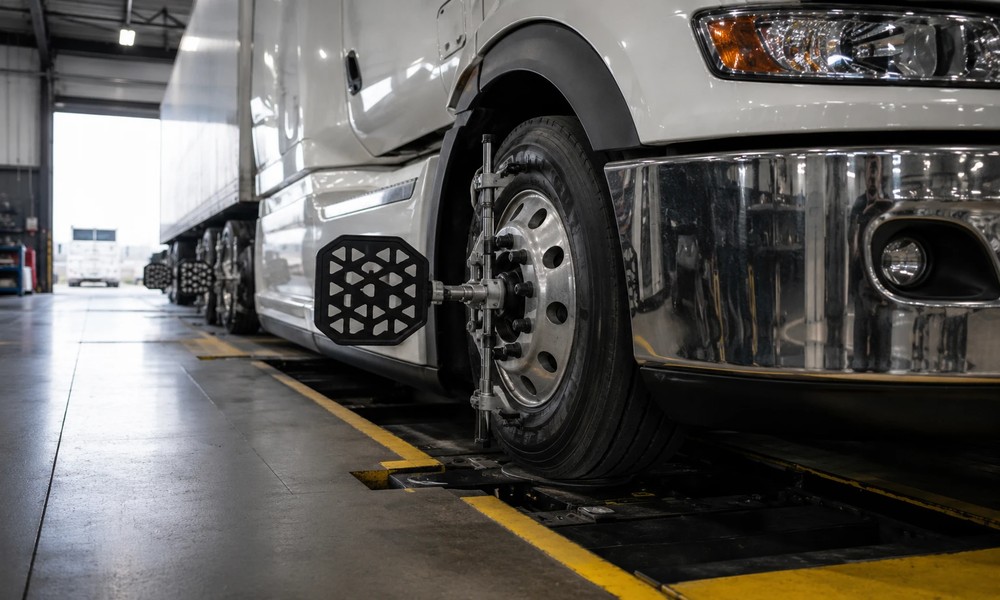
Drive axle thrust angle measurement follows, using laser or camera-based equipment to determine the actual direction each drive axle is pushing the vehicle. If drive axle thrust angle is outside specification, it is corrected – or documented as a limiting factor on steer axle adjustment – before any steer axle work begins. Only after the thrust geometry of the vehicle is established does the technician adjust the steer axle toe and caster to bring everything into specification simultaneously.
For tractor-trailer operations, trailer axle alignment should be checked during the same service appointment whenever possible. Trailer axle misalignment that is transmitting side forces through the fifth wheel to the tractor cannot be corrected by adjusting the tractor alone – it requires either correcting the trailer axle alignment or documenting the trailer condition and rotating that trailer out of service until it can be properly addressed.
Alignment and the Broader Maintenance Picture
Wheel alignment does not exist independently of the other systems it interacts with. Proper alignment requires mechanically sound steering and suspension components to hold their positions after adjustment. A truck with worn kingpins, loose tie rod ends, deteriorated wheel bearings, or compromised suspension bushings cannot maintain alignment settings even if the adjustment is performed correctly – the worn components allow the geometry to shift back out of specification under driving loads.
This means that a complete alignment service on a high-mileage truck begins with a steering and suspension inspection that identifies worn or damaged components before any alignment adjustment is made. Adjusting the toe on a truck with worn tie rod ends produces a result that will be out of specification within weeks as the worn joints allow the toe to drift. The correct sequence is inspection, component repair or replacement where needed, then alignment adjustment – in that order.
Tire inflation is another alignment interaction that is frequently overlooked. An underinflated tire contacts the road differently than a properly inflated tire, which changes the effective camber and contact patch geometry in ways that can mimic alignment-induced wear patterns. Before attributing irregular tire wear to alignment, verifying that inflation pressures are correct for the load on each axle is an essential diagnostic step. Alignment service performed on tires at incorrect inflation pressures will not produce the results that service at correct pressures would.
The Bottom Line
Commercial truck wheel alignment is a maintenance investment with a measurable and relatively rapid return. The fuel savings and tire life extension that result from properly aligned trucks typically recover the cost of alignment service within the first few thousand miles of operation following the service. Extended over a full tire service cycle, the economic argument for disciplined alignment maintenance is straightforward: tires that last to their intended service life rather than being scrapped early for irregular wear represent substantial direct savings, and fuel economy improvements compound those savings across every mile the truck travels.
The alignment picture on a commercial truck is more complex than on a passenger vehicle, and the consequences of neglecting it are proportionally more expensive. Understanding what steer axle, drive axle, and trailer axle alignment each contribute to the overall system, recognizing the tire wear patterns that signal developing problems, and scheduling all-axle alignment service at appropriate intervals and after triggering events are the specific practices that protect both tire budgets and equipment longevity over the operating life of a commercial vehicle.