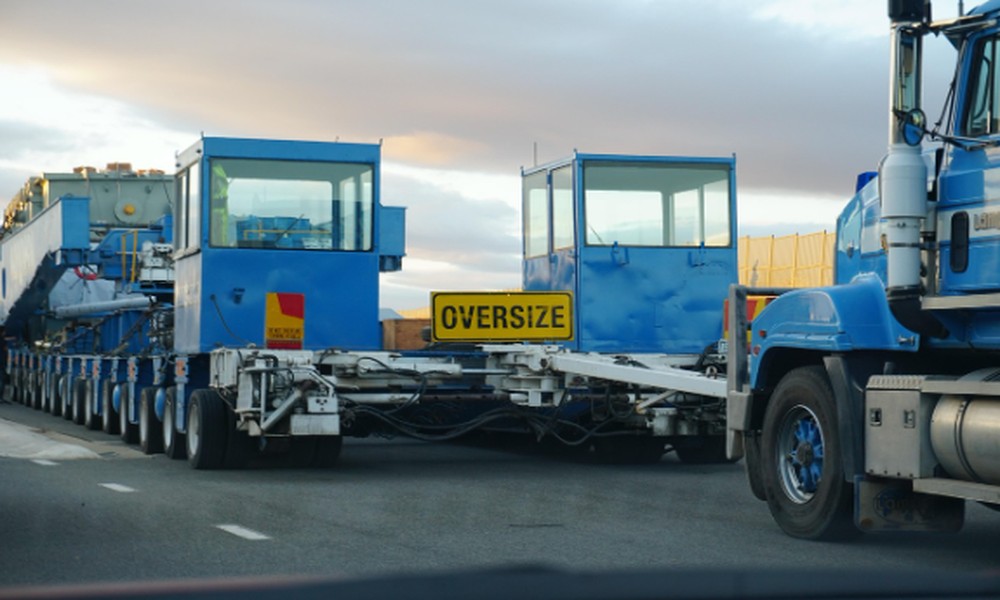
At a glance:
- The feasibility of routes and infrastructure capacities might be overlooked in oversized transport projects.
- The layered and conditional approval process of heavy haulage projects can affect delivery schedules.
- Project teams should understand that load configuration and weight distribution affect regulatory compliance, delivery timelines and safety.
- Most cost overruns occur from unmanaged risk and poor coordination during delivery.
Oversized transport is often viewed as a larger version of standard freight. If a load can fit on a trailer and the road is clear, you may assume it can be moved easily from point A to point B.
At first glance, it may seem like a straightforward logistics task involving heavy equipment. However, oversized transport is much more complicated. It requires engineering checks, regulatory approvals and careful coordination. Small assumptions during planning can result in major delays and last-minute changes that disrupt overall project timelines.
This article outlines the factors often underestimated in oversized transport projects and explains why addressing them early protects timelines and budgets.
Route Feasibility Requires Engineering Validation
A common misconception in oversized transport projects is that if a road connects two locations, it can support the load. In practice, a formal route feasibility assessment is needed to confirm bridge load limits, pavement classification and geometric constraints like turning radii and gradients.
Infrastructure that supports standard freight may not withstand the concentrated axle loads involved in over-dimensional transport. These engineering checks determine viability before any permit is issued.
External constraints are often underestimated as well. Overhead utilities, traffic infrastructure and council-controlled assets can require approvals or temporary adjustments. Engineered routes for oversized loads may be longer because they avoid structural limitations. That added distance or reduced speed can affect delivery commitments.
Regulatory Approvals Influence Project Timelines
Heavy haulage projects follow strict compliance rules. Approvals for transporting abnormal loads include specific conditions on dimensions, axle configurations and approved routes. You may view permits as standard, but each application is evaluated on its own merits and may involve multiple authorities.
Similarly, curfews, escort availability and limited travel times can influence timing more than distance. Even minor dimensional changes can require reapplying for transport permits. When regulatory timeframes are underestimated, project timelines can quickly tighten.
Load Configuration Impacts Compliance and Safety
In heavy equipment transport, compliance depends on weight distribution, not only on total mass. Axle group loading has a significant impact on bridge load limits and pavement stress, and any miscalculation can delay approval. This technical detail is often missed during procurement, as the main focus is on gross weight.
Restraint systems also require engineered design and verification. Tie-down calculations, transport frames and dynamic load considerations are structural requirements.
Implementing transport planning only after fabrication can impose design constraints that limit configuration options and increase risks during transport.
Risk and Cost Exposure Expand with Scale
As transport distance increases, operational uncertainty also increases. Oversized transport that crosses regions or state borders must adapt to different road conditions, weather patterns and regulations. These shifts add layers of operation and compliance that are often overlooked in early planning.
Heavy haul projects depend on backup measures like escort coordination, recovery access and extra equipment. Without these, a single disruption can escalate rapidly.
For example, if a load breaks down while travelling and there is no backup plan, the costs of standby cranes and re-permitting can exceed the original freight rate.
Final Delivery Demands Precision Coordination
The final phase of oversized load transport is often assumed to be straightforward. However, site access geometry, ground bearing capacity and internal traffic flow must be validated before arrival. Public road clearance does not guarantee on-site suitability.
Timing precision is equally important. Crane bookings, shutdown windows and installation milestones create narrow delivery windows. Transport crews must work in close coordination to avoid disruption. In oversized load transport, final placement is often the most time-sensitive stage.
Oversized transport projects rarely fail simply because of the loads’ mass or dimension. They struggle when planning is driven by assumptions rather than engineering validation, regulatory strategy and coordinated execution. In addition, route feasibility, permit conditions, load configuration, risk planning and final delivery each carry technical and commercial implications. These factors require thorough planning and coordination from the earliest project stages.
Experienced heavy haulage specialists can help you identify risks before they become costly disruptions. Involving them early in the planning stage helps bring greater certainty in transport logistics, schedules and overall project delivery.